

10 Questions To Ask Before Signing the Fabrication Work Order
A signed fabrication work order is a binding contract that sets a project's trajectory. A single oversight or ambiguous clause can lead to costly rework, project delays, and compromised quality. Imagine receiving a shipment of fabricated components only to discover they fail to meet dimensional tolerances or that they changed the specified material grade. The financial and reputational damage is significant.
To prevent these outcomes, you need a verification process that gives absolute clarity before any work begins. This guide outlines the 10 questions to ask before signing the fabrication work order to mitigate risks for project success.
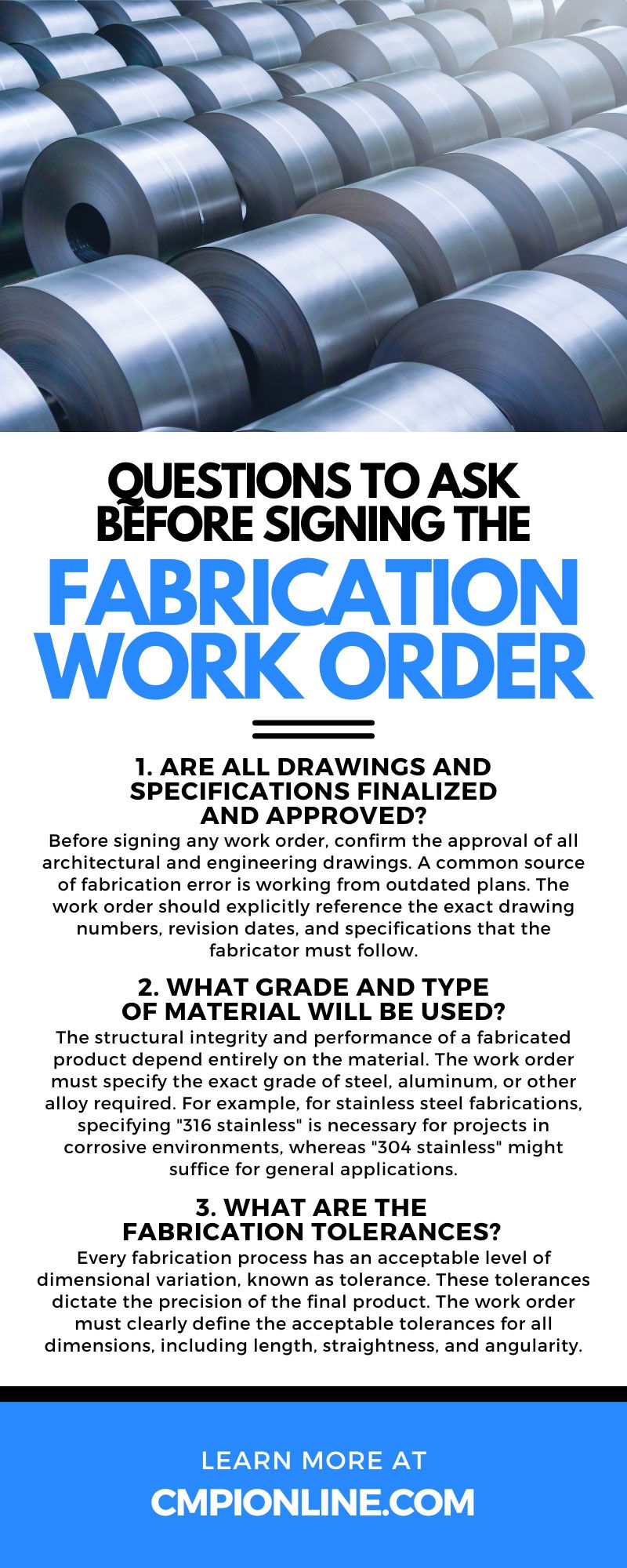
1. Are All Drawings and Specifications Finalized and Approved?
Before signing any work order, confirm the approval of all architectural and engineering drawings. A common source of fabrication error is working from outdated plans. The work order should explicitly reference the exact drawing numbers, revision dates, and specifications that the fabricator must follow.
Clearly document details such as dimensions, material callouts, finish requirements, and assembly instructions. For complex projects involving custom components, a final review with both your design team and the fabricator’s project manager is a step to align all stakeholders. This prevents misinterpretations that could lead to non-conforming parts.
2. What Grade and Type of Material Will Be Used?
The structural integrity and performance of a fabricated product depend entirely on the material. The work order must specify the exact grade of steel, aluminum, or other alloy required. For example, for stainless steel fabrications, specifying "316 stainless" is necessary for projects in corrosive environments, whereas "304 stainless" might suffice for general applications.
Ask the fabricator if they will provide mill test reports (MTRs) for the materials. These documents trace the material back to its source and certify its chemical and physical properties, confirming compliance with standards from organizations like ASTM International. This documentation is a requirement for architectural projects, structural components, and high-specification industrial equipment.
3. What Are the Fabrication Tolerances?
Every fabrication process has an acceptable level of dimensional variation, known as tolerance. These tolerances dictate the precision of the final product. The work order must clearly define the acceptable tolerances for all dimensions, including length, straightness, and angularity.
If your project requires tight tolerances for assembly or aesthetic purposes, you should agree in writing to these specifications. Discussing tolerances upfront helps the fabricator determine the appropriate machinery, processes, and quality checks needed. Without this clarity, a fabricator may default to their standard tolerances, which might not meet your project’s needs.
4. How Will Quality Control Be Managed Throughout the Project?
A quality management system (QMS) contributes to a successful fabrication project. Ask the fabricator to detail their quality control procedures. This includes in-process inspections, final inspections, and any non-destructive testing (NDT) methods they will employ, such as dye penetrant, magnetic particle, or ultrasonic testing for welds.
Confirm who is responsible for quality assurance and how they will document and report their findings. For large projects, schedule your own inspections or hire a third-party inspector at key milestones. Quality control minimizes the risk of discovering defects after delivery of the product.
5. What Welding Procedures and Welder Certifications Apply?
A welding work order should specify the required standards, such as those from the American Welding Society (AWS) or the American Society of Mechanical Engineers (ASME). For structural applications, AWS D1.1 is a common standard for steel.
Furthermore, inquire about the qualifications of the welders who will work on your project. Request copies of welding procedure specifications (WPS) and procedure qualification records (PQR) to verify that the fabricator has a documented and proven method for producing sound welds.
6. How Will Materials Be Handled To Prevent Contamination?
Material handling is especially important for stainless steel and aluminum fabrication. For example, you can contaminate stainless steel if it touches carbon steel tools, work surfaces, or grinding dust. This leads to surface rust and compromises its corrosion resistance.
Ask the fabricator about their procedures for preventing cross-contamination. This involves a dedicated fabrication area, separate tools, and protective coverings. Proper handling protocols indicate a professional and experienced fabrication shop.
7. What Surface Finish Is Required and How Will It Be Protected?
The surface finish impacts both the aesthetics and performance of a fabricated component. If you require a #4 brushed finish on stainless steel, a powder-coated finish on aluminum, or a hot-dip galvanized coating on steel, the exact specification must be in the work order.
Equally important is how the fabricator will protect this finish during fabrication, handling, and shipping. This may involve applying a protective PVC film, using specialized packaging, or carefully planning the logistics to prevent scratches and damage. Confirm these details for a product that arrives at your site in the condition you expect.
8. What Is the Detailed Project Timeline and Delivery Schedule?
You will need a clear and realistic timeline for planning site activities. The work order should include a projected start date, fabrication milestones, and a firm completion date. Discuss potential factors that could cause delays and how they will communicate with you about them.
Clarify the delivery terms (Incoterms), including who is responsible for logistics, transportation costs, and unloading at the site. A well-defined schedule coordinates subcontractors and keeps the entire project on track.
9. What Is the Process for Handling Change Orders?
Changes are common in complex projects. A defined change order process can manage modifications without derailing the project. The work order, or an accompanying document, should outline how you request, price, and approve changes.
Having a formal system prevents disputes over unapproved work or unexpected cost overruns, allowing all parties full transparency.
10. What Warranties or Guarantees Are Provided?
Finally, understand what warranties the fabricator offers on their workmanship and the materials that they use. A reputable fabricator will stand behind their work. The work order should clearly outline any warranties, including the duration and what they cover. This provides recourse in the unlikely event that a defect or failure occurs after installation.
Partner With an Expert in Custom Fabrication
Ask ing these 10 questions before signing the fabrication work order aligns expectations, mitigates risk, and builds a foundation for a successful partnership with your fabricator. Taking the time for this due diligence protects your investment, your timeline, and your reputation.
At Custom Manufacturing & Polishing Inc., we build partnerships with clarity, quality, and expertise. Our team can answer these questions and more for a project to meet the highest standards of precision and performance. Contact Custom Manufacturing & Polishing Inc. today and discuss your next fabrication project with the CMPI experience difference.