



Deep Burial vs. Surface Plate Bollard Anchoring
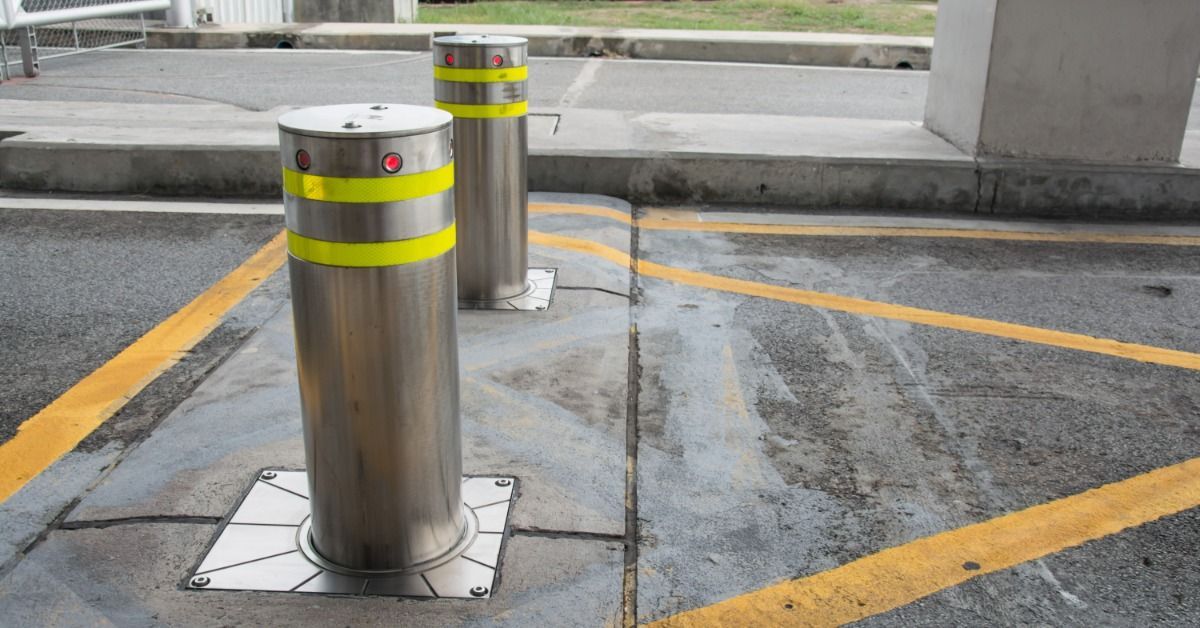
The way a bollard connects to the ground affects how the installation responds when lateral force reaches the post. Deep-burial systems extend below grade into a concrete foundation, while surface-mounted systems use a base plate and anchors to connect the bollard to concrete at the surface. Each method creates a different path for transferring force away from the post.
Choosing between deep-burial and surface-plate bollard anchoring requires the examination of how each system transfers force to provide a stronger basis for evaluating the installation before fabrication begins.
How Deep Burial Transfers Force Below Grade
With deep burial, a portion of the bollard extends below the finished surface and into a concrete foundation. When lateral force acts on the exposed post, the embedded section transfers that force into the surrounding foundation.
Foundation requirements depend on the conditions of the individual installation. Project teams therefore need to account for the planned foundation and site conditions when establishing how the bollard will connect below grade.
How Surface Plates Transfer Force Into Concrete
Rather than extending the post into a below-grade foundation, surface-mounted installations transfer force through a base plate secured to the concrete with anchors. This connection makes the plate and anchor points responsible for moving force from the bollard into the supporting concrete.
Because the post does not extend into a below-grade foundation, the base plate and anchors become central parts of the load path. The supporting concrete must accommodate the specified anchoring system rather than simply provide a surface beneath the bollard.
Compare Impact Requirements Before Choosing an Anchor
Although the anchoring method influences how force moves through the installation, it does not determine impact performance on its own. The bollard construction and connection details work together with the anchoring system to determine how the complete assembly responds to lateral force.
Project teams therefore should not treat deep burial or surface mounting as an automatic indicator of impact resistance. When a project has defined impact requirements, the bollard and its anchoring system need to address those requirements as a complete assembly.
Account for Conditions at the Installation Site
Below-grade conditions can influence whether deep burial works with the planned installation. Excavation requires adequate space around the bollard location, while underground conditions can affect where project teams can place the foundation.
Surface mounting avoids embedding the bollard itself, but it places greater emphasis on the concrete receiving the anchors. When planning stainless steel pipe bollards, project teams should evaluate the intended loading conditions alongside the structure that will receive those forces.
Select Anchoring Around the Required Load Path
Choosing between deep-burial and surface-plate bollard anchoring ultimately depends on how the installed assembly needs to transfer force. Deep burial directs forces into a below-grade foundation, while surface mounting relies on the base plate, anchors, and supporting concrete to complete the load path.
Establishing the mounting requirements before fabrication allows the bollard configuration to reflect the planned installation. CMPI fabricates stainless steel bollards for commercial and industrial applications and can incorporate established mounting requirements into the finished components. Contact CMPI to discuss bollard fabrication for your project.